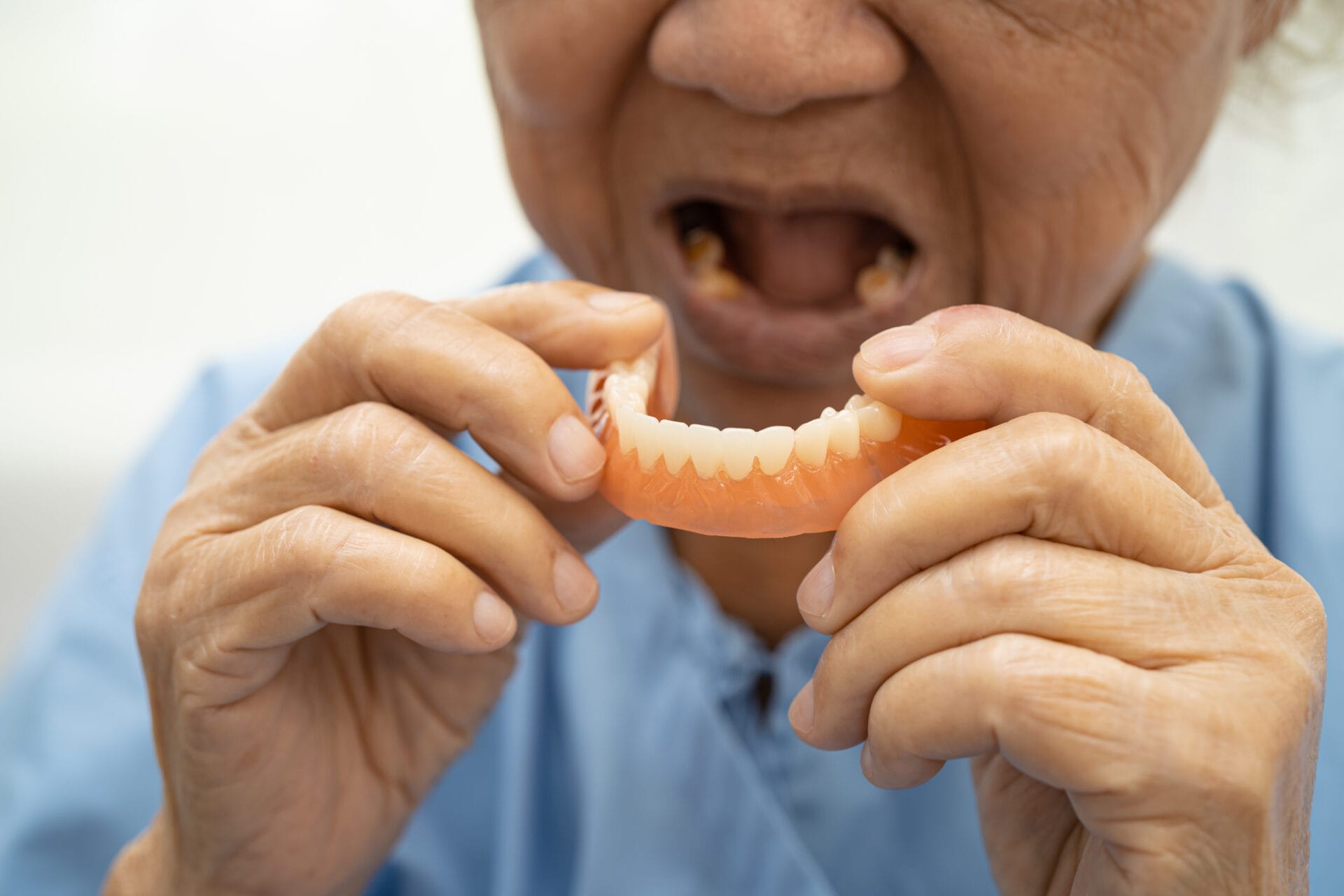
A loose denture is more than a small annoyance. It changes what you eat, how you laugh, and whether you feel comfortable speaking in a meeting. At Palm Beach Dental, we talk with patients from Palm Beach, Elanora, Currumbin and West Burleigh every week who have spent months — sometimes years — using adhesive paste to keep a denture in place that no longer fits. Our team, led by principal dentist Dr Jijesh Nhalila-Valappil (Masters in Public Health, ADA and AACD member), takes the time to understand why the denture has lost its grip and to walk you through every realistic fix — from a same-day reline to a fixed implant solution.
Why do dentures become loose over time?
A denture loosens because the jawbone beneath it gradually shrinks after the natural teeth are removed, a process called bone resorption. The denture was made to fit the shape of your jaw on the day it was fitted; over the following months and years, the gum and bone change shape but the acrylic does not. The result is a plate that rocks, lifts when you chew, or slips when you speak.
Several factors accelerate the resorption: length of time since the teeth were removed, gum disease history, smoking, and long-term denture wear without relines. Most patients notice the change gradually — first as a need for more adhesive, then as sore spots, then as the denture lifting during meals. The Australian Institute of Health and Welfare reports that around 1 in 5 adults aged 65 and over wear a removable denture, so the pattern is common.
The good news is that the underlying cause — bone loss — is now treatable. Stabilising a loose denture with dental implants addresses the root problem rather than just the symptom.
What is a denture reline and how does it help?
A denture reline is a procedure that adds a new layer of soft or hard material to the fitting surface of the denture so it matches the current shape of your gum. It is the simplest, most affordable fix for a loose denture, and in many cases it can be completed in a single visit.
A soft reline uses a cushioned material that stays pliable for 1–2 years and is kinder to tender gums. A hard reline uses a durable acrylic that is processed in a lab and typically lasts 3–5 years. Your dentist will recommend the right type based on how much your gum has changed and whether you have any sore spots.
A reline, however, is a temporary fix. If the bone has resorbed significantly, a reline will restore comfort for a year or two but the denture will loosen again as the gum continues to change. Patients who want a permanent solution usually move on to consider implant-retained options.
How can dental implants stabilise a loose denture?
Dental implants stabilise a loose denture by anchoring it to 2–4 titanium screws placed in the jawbone, which the denture then clicks or clips onto. Because the implants are fixed in the bone, the denture no longer relies on suction, adhesive, or gum shape to stay in place.
There are three broad implant-based options for denture patients:
| Option | How it works | Removability |
|---|---|---|
| Implant-retained overdenture (2–4 implants) | Denture clips onto implant attachments | Removed daily for cleaning |
| All-on-4 / All-on-X (4–6 implants) | Fixed full-arch bridge screwed onto implants | Not removed by patient |
| Subperiosteal implants (low bone) | Custom metal framework above bone, supports fixed teeth | Not removed by patient |
Each option uses the same biological principle — the implant fuses with the jawbone through osseointegration — but suits different clinical situations. Patients with adequate bone can usually have conventional implants; patients with significant bone loss may be better suited to subperiosteal implants, which do not require grafting.
What is an implant-retained overdenture?
An implant-retained overdenture is a removable denture that clips onto 2–4 dental implants via ball or bar attachments, providing a firm hold without adhesive. It is the most common step-up from a conventional loose denture, particularly for patients who want a removable prosthesis they can clean easily at home.
Compared with a standard denture, an overdenture offers three measurable improvements: it stays in place during speech and eating; it preserves more jawbone because the implants stimulate the bone during chewing; and it eliminates the daily cost and mess of adhesive. Clinical studies cited by the Australian Dental Association consistently show that 2-implant overdentures significantly improve quality-of-life scores for edentulous patients compared with conventional dentures.
The overdenture itself is removed at night for cleaning, but the implants remain fixed in the jaw. For patients who prefer a non-removable option, the All-on-4 technique provides a fixed arch that stays in the mouth at all times and functions like natural teeth.
How much do implant-retained dentures cost in Palm Beach?
Implant-retained overdentures in Palm Beach are priced from AUD 3,999 per single implant (with crown or attachment), with a 4-implant bridge from AUD 9,999 and an All-on-4 / All-on-X full arch from AUD 15,999. All figures are taken from the practice’s published price list.
Sedation is priced separately. Sleep (twilight) sedation costs AUD 599 per hour and nitrous oxide “happy gas” costs AUD 99 per hour, which makes longer surgical visits more comfortable for anxious patients. Afterpay splits the cost into four interest-free instalments due every two weeks; the National Dental Plan (Humm) offers longer interest-free plans; and eligible patients can apply for early release of superannuation through the ATO. All major Australian health funds and Veterans Affairs are accepted.
The total cost for a 2-implant overdenture is generally the most affordable fixed solution and is the typical starting point for patients who simply want their existing denture to stop moving.
How long does it take to convert a loose denture to a fixed one?
Converting a loose denture to a fixed, implant-supported restoration takes 3–6 months in total, including surgery, healing, and fabrication of the final prosthesis. The exact timeline depends on whether you need extractions first, whether bone grafting is required, and which implant option you choose.
A typical journey looks like this: initial consultation with 3D X-ray (1 visit); implant surgery with possible same-day temporary (1 visit); healing and osseointegration (3–6 months); final impressions and fit-out of the new overdenture or fixed arch (1–2 visits). For patients with low bone who need subperiosteal implants, the surgery is more involved but the same overall timeline applies.
Frequently asked questions
Can my existing denture be converted into an implant denture? Often yes. If your current denture fits well and is in good condition, it can sometimes be modified to clip onto newly placed implants, which saves the cost of a new prosthesis.
Do implant dentures hurt? Implant surgery is performed under local anaesthesia. Sedation options are available for anxious patients. Most people describe the recovery as milder than having a tooth removed and manage it with over-the-counter pain relief.
Will I still need adhesive? No. The whole point of an implant-retained denture is to remove the need for adhesive. Most patients find they forget they are wearing it.
How do I clean an implant-retained denture? A soft brush, non-abrasive cleanser, and daily cleaning around the implant attachments are usually enough. Your dentist will show you the right technique during the fit appointment.
Is the procedure safe for older patients? Yes. Age itself is not a barrier — overall health and bone quality matter more. The team will review your medical history and any medications before recommending a treatment plan.
Where Can You Receive Denture Stabilisation in Palm Beach?
If you are looking for a fix for a loose, ill-fitting denture in Palm Beach or the Gold Coast, personalised assessment makes a difference. At Palm Beach Dental, loose dentures are approached with a calm, patient-first conversation about why the fit has changed. From a same-day reline through to dental implants and All-on-4 dental implants — including subperiosteal implants for low-bone patients — the focus is on the option that fits your mouth, your goals, and your budget. Whether it is a clip-on overdenture or a fixed full arch, every patient receives guidance tailored to their specific denture needs, helping support long-term comfort and confidence. neighbouring Currumbin patients travel just minutes south along the Gold Coast Highway to begin.
Disclaimer: All dental procedures involve potential risks and benefits. The information provided in this blog is general in nature and should not be taken as medical advice. We recommend that you seek guidance from a suitably qualified health professional before making decisions about your oral health. Where appropriate, you may also wish to consider obtaining a second opinion. Any images or videos featured are shared with the informed consent of our patients and are intended for educational purposes only. They are not a guarantee of results, as every patient is unique. Treatment outcomes — including recovery, potential complications, and effectiveness — can vary from person to person.
References
- Australian Dental Association. Dentures and Implant Solutions. https://www.ada.org.au/
- Healthdirect Australia. Dentures. https://www.healthdirect.gov.au/
- Palm Beach Dental. Price List. https://palmbeachdental.com.au/price-list/
- Palm Beach Dental. Dental Implants in Palm Beach. https://palmbeachdental.com.au/services/dental-implants/
- Palm Beach Dental. All-on-X Dental Implants in Palm Beach. https://palmbeachdental.com.au/all-on-4-x-dental-implants/
- Palm Beach Dental. Subperiosteal Implants in Palm Beach. https://palmbeachdental.com.au/subperiosteal-implants/